Stop teaching every coding agent your design from scratch.
Agents may improvise. They may not confuse improvisation with authority.
Design Authority turns your existing screens, brand kits, and design decisions into a shared standard that AI coding agents can follow. Agents stay consistent, show where they improvise, and bring new decisions back for human review. The standard evolves without losing its history.
For product teams building interfaces with agents.
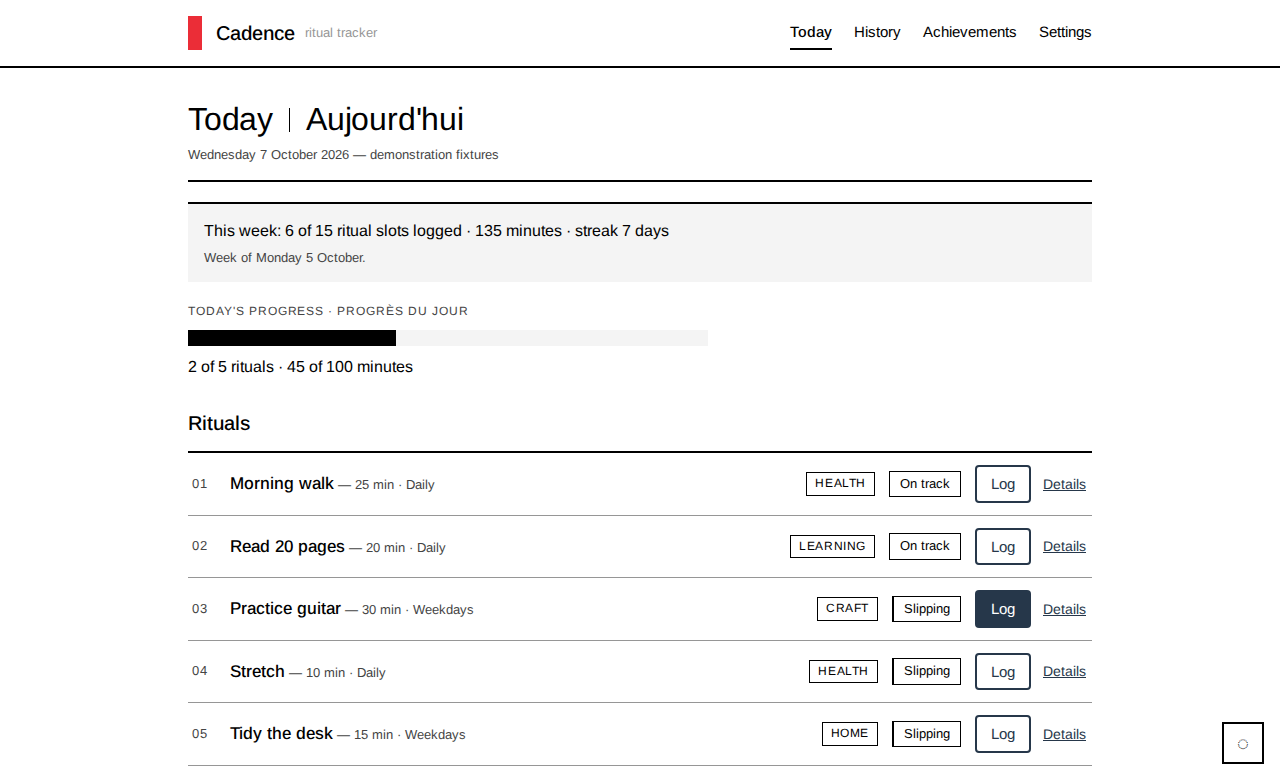
One app, three design authorities.
The same habit-tracker brief, built three times, once under each authority. Same features, same copy, no shared code.
Every build carries the lens: press ◌ to reveal its improvisations, then click a dashed element to inspect its case.

Wink · expressive

Leader · editorial
Dominion · institutional
How a Design Authority is created, used, and evolved.
existing product · brand kit · cases
observes, infers, and identifies what remains unknown
ObservedInferredUndefined
accept · modify · reject · leave open
published, versioned, executable norms · everything downstream cites it
follow the canon, resolve and compose, and mark every improvisation
independent checks inspect the actual implementation, not the agent's claims
two consumers of one authority
gaps · conflicts · proposals · fails
adjudicate what should change
validated and added to the next authority release
rationale archived and retrievable; canon unchanged
Future agents inherit the updated authority and the decision history.
Inference isn't authority. Machines propose what the evidence means; humans decide what becomes binding.
Every decision leaves a trace. Whether promoted, rejected, or deliberately unresolved, it remains available to future agents.
What happens when authority has no answer?
Nothing is silently invented. A single need, tracked through the whole loop, from a build that had to improvise to the recorded decision the next build can consult.
-
ask
Building the tracker under the Dominion authority, the agent needs paging for older entries.
-
authority is silent
resolve "pagination for older entries" → UNDEFINED. There is no paging canon, and inventing one silently is not allowed.
-
improvise visibly
The build ships outline buttons plus a plain readout. The decision is marked as noncanonical, like every unrecorded decision in the stress builds.
-
gap filed
gap/20261007-150030-e4273f lands in the workspace ledger.
-
human adjudication
Review finds partial evidence and no live-product instance. The outcome is neither canon nor discarded; it is ruled a provisional candidate with a promotion bar.
-
memory
Today the same ask still returns UNDEFINED, with Paging composition (provisional) attached, and the bar it must meet to become canon. The next build inherits the outline without mistaking it for authority.
Improvised work stays visibly noncanonical: in the Cadence builds every element outside authority carries a mark and a filed gap; the ◌ toggle reveals them. See one live.
Nothing was silently invented, and nothing was lost.
Measured results, and current limits.
Measured
Where an authority ran out, the builds improvised visibly. Every unrecorded decision was marked and every gap was filed. The rebuilds track the authorities as they codified, from v1 on the raw authority to v3 on the codified release. Eleven accepted proposals became canon, and twenty-five recorded declines now steer later asks toward sanctioned alternatives.
The Triage authority: 80 artifacts, 19 rules, 53 calibration cases, its own lint engine at score 100, and a natural-language coverage sweep at 134 of 134.
On record
One reversal from the Phantom extraction, kept with its reason.
-
ask
Extract a design authority for the Jennu portfolio, from the deployed site.
-
first reading
The machine read the markup and the template's defaults, and canonised grey reading ink. Tidy, plausible, and wrong about the product.
-
owner review
The rendered result was checked against the live site and rejected. The site paints its reading text pink (#ff6bbc) with neon green links (#6bff2c). An authority has to describe what is actually there.
-
redo
Pass 2 re-extracted from rendered evidence: screenshots first, several extractors partitioned by domain. The deployed ink map became canon.
-
reversal on record
precedent/pink-ink-canonised supersedes the pass-1 declination. The measured contrast failures stay as observations, bounded by a prohibition that keeps the pattern inside its measured roles.
-
memory
Future agents read the pink ink as canon and can still retrieve why grey was wrong. The rejected reading was not deleted; the reversal is part of the record.
Limits
Level 2 conformance is partial and declared per component. Levels 3 and 4 are proposed. Nobody has yet shown that compliant builds behave better in users' hands. That experiment is next. An authority is not a Figma library, not a lint config, and not a way to lock people in.
Explore the authorities and the details.
The catalogue, the mechanics, and the ledger. None of this is required reading.
The catalogue
Every authority on this site, with the pages and the demo apps built from each.
Triage
v0.12.1The app-agnostic paper-and-ink design authority. 80 artifacts, 19 rules, 53 calibration cases.
audit · duty console · foundations · pack
Phantom
v0.2.0The deployed language of zhenyoyo.github.io, extracted screenshot-first; one reversal on record. 29 artifacts, 21 calibration cases.
audit · jennu review · learn
Wink
v0.2.0The Mailchimp brand and live product, codified. 17 artifacts, 18 calibration cases.
Leader
v0.2.0The Economist's Marber system and live product, codified. 15 artifacts, 14 calibration cases.
This page itself is built under the Triage authority. Its foundations are verbatim; the chrome is marked and filed. See the ledger.
Under the hood
In precise terms, a design authority is a versioned, machine-readable record of an interface system. Implementation agents are instructed to resolve decisions against the authority, while independent verification checks observable conformance. Decisions that would otherwise happen by default get written down, cited, and versioned.
authority-triage/   (the Triage pack, its own repository)
  authority.json      identity · version · consumers
  artifacts.json      80 records: components, token sets, patterns, guidelines
  rules.json          19 enforceable rules (TDS001–015 + interaction)
  golden.json         53 calibration cases: ask, expected, got
  verification.json   claims a verifier can test against a build
  AGENT-PROMPT.md     the consumption protocol for coding agents
{
  "id": "component/px-sw",
  "kind": "component",
  "title": "Switch",
  "summary": "the square switch; track 26×15, thumb 11×11",
  "states": ["default", "hover", "focus",
             "checked", "disabled"],
  "verify": ["[data-sw]",
             "checked toggles aria-checked"]
}
The resolver
resolve "a switch" → component/px-sw
resolve "rounded corners on the cards" → CONFLICT (do not implement as requested)
| Outcome | Fires when | The build does |
|---|---|---|
| RESOLVED | the element matches a recorded artifact | build it the recorded way |
| COMPOSE | the element combines recorded parts | assemble only in recorded ways |
| FALLBACK | the environment cannot support the primary answer | follow the recorded degradation |
| UNDEFINED | authority has no answer | implement locally if necessary, mark it as noncanonical, keep the provenance, and file the gap. Never present it as canon |
| CONFLICT | the request contradicts a prohibition | stop and escalate; do not implement as asked |
Two consumers, one record
- 1Resolve
Implementation agents are instructed to resolve decisions against the authority.
- 2Build
The implementation follows the records. Deviations are choices, and choices are recorded.
- 3Verify
Independent verification checks observable conformance. Agent self-report is evidence, not proof.
- 4Report
Conformance comes back per rule with its evidence. A score is a gate, never proof.
- 5Adjudicate
Conflicts and gaps become precedents and versions, not lost threads.
Every pass leaves a traceable decision, even when the authority itself remains unchanged.
Verification levels
| Level | Checks | Status |
|---|---|---|
| L1 · Static | tokens, selectors, declarations, structure | shipped |
| L2 · Behavioural | keyboard, focus restoration, state transitions, lifecycle | partial, declared per component |
| L3 · Rendered | screenshots, overflow, zoom, dark mode, reduced motion | proposed |
| L4 · Product | real workflows: task success, error recovery, comprehension | proposed |
Every conformance claim cites its rule, its implementation, and its evidence. The proposal lives in the Triage repository, at spec/proposals/verification-levels.md.
Version mechanics
Editorial edits ship as patches
Wording, examples, and citations ship as 0.1.x patches, with no re-freeze.
Semantic changes get a fresh freeze
Changes to pipeline order, thresholds, or record formats get a fresh freeze at 0.2 and up. A build is always checkable against the authority it was built on.
Reversals become precedents
When a decision is overturned, the reversal is recorded with its reason and cited by id. Nothing is quietly overwritten.
Ambitions wait in candidates
An idea enters with the condition that would promote it. Scope grows by evidence, not enthusiasm.
 v0.12.1
Don't know what to try it with? Try Triage, a modern minimalist design kit designed for Design Authority. It ships as its own pack: 80 artifacts, 19 rules, a lint engine that checks a build, and byte-identical foundations for consumers.
get the pack · docs site · audit
git clone --depth 1 https://github.com/vjsyong/authority-triage.git
python3 tools/da.py --pack authority-triage overview
# expected: triage 0.12.1 - 80 artifacts
Authority ledger · how this page was built
Resolved, used as recorded. Triage tokens and core styles, verbatim (byte-identical). Components with records: buttons, chips, status dots, tables (with the recorded mcards phone reflow), and the version timeline (component/tl).
Checked. The Triage lint engine over this site: 0 errors · 0 warnings · spec score 100.
Improvised, marked ◌. The page chrome has no authority record yet. That covers the site header, hero layout, CTA row, app showcase, loop diagram, step row, proof rows, docs code blocks, and editorial grids.
Gaps filed to the workspace ledger (workspaces/designauthority-site):
- gap/20261008-083133-3f94cd · card / surface container
- gap/20261008-083133-1a7e2b · note / callout
- gap/20261008-083133-8c96f6 · docs code block
- gap/20261008-083133-a3c590 · editorial card grids
- gap/20261008-083133-4e941d · step row and loop diagram
- gap/20261008-083133-ab794e · site header for paper pages
- gap/20261008-105306-8a654b · section kicker above headings
- gap/20261008-105306-bdadaa · showcase media card
Proposed, awaiting review. prop/20261008-105323-1d4022 · a section kicker above headings (candidate).
12 marked · 8 gaps filed. Dashed outlines; hover for the reason.